

The fall and rise. . .
by CAROLE SPENCER
MENTION the Italian Spinone in doggy company and someone is sure to say, "Oh yes, that's the one with the funny topline isn't it".
Yet, to the Spinone enthusiast there is much more to this delightful breed than its unusual topline, his charming docile nature for one, but as with any new breed to the country it takes time for judges to get to know the breed and patience and good sportsmanship on the part of the exhibitors.
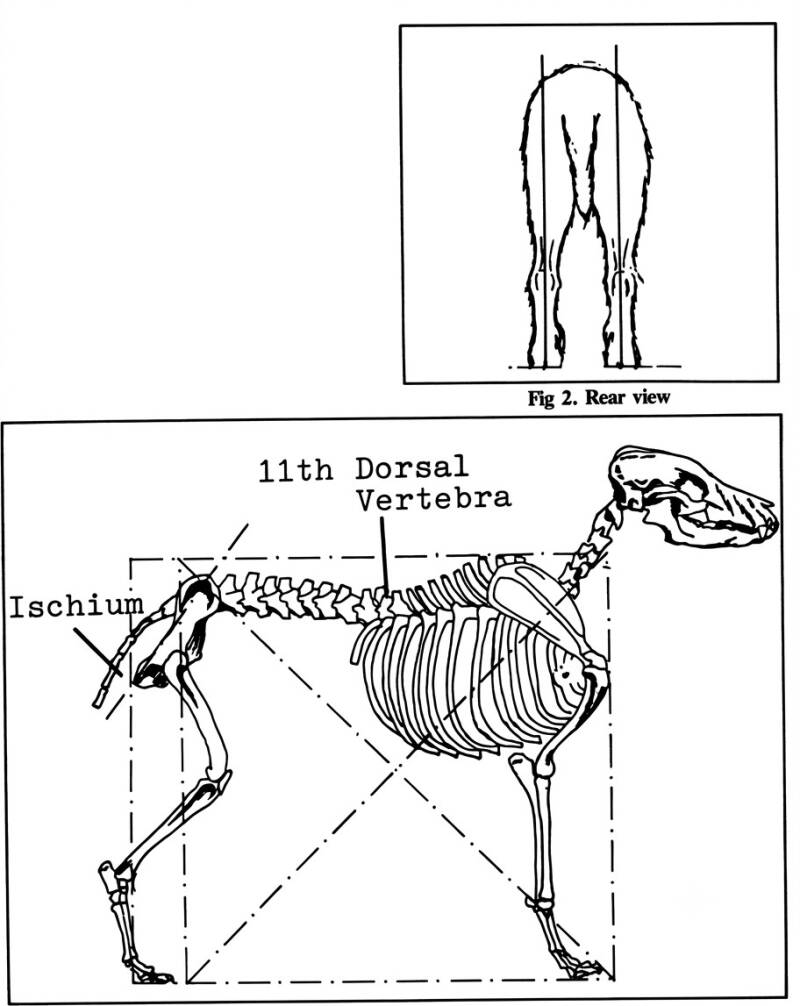
Firstly the now legendary topline. To quote the Standard: "The withers are raised above the backline, the upper profile of the back being made up of two lines . . . one almost straight slopes at 15 degrees from the withers to the eleventh dorsal vertebra, the other slightly arched rises from this vertebra to the croup".
In other words there is only a slight slope behind the shoulders, any more than this is a fault (saddleback).
The Spinone is square in outline therefore to assess the topline, viewed from the side the midline of the hock should be in line with the ischium point of the pelvic bone (see fig 1); to see the legs set further back than this completely alters the topline.
When viewed from the rear the backline from the point of the hocks to the ground should be on the vertical and on the extension of the buttock line (see fig. 2); setting the feet wide apart or over-stretching will disguise a bad topline.
Another two breed points of the forequarters which differ from others in the gundog group are the width between the points of the shoulders which are not close together but rather well set apart, and the angle of the pastern — one could be forgiven for saying that a Spinone is down on the pastern. He is essentially a working dog with webbed feet designed to tread the marshes and swampland of Northern Italy.
The front feet should be compact with well closed arched toes, the hind feet are slightly oval. There is no mention in the Standard that the feet should be big but obviously they must suit the size of dog. The bone of the forearm should be oval in shape.
On the hindquarters the angulation of the hocks is open because of the slight slope of the tibia suggesting a moderate bend of stifle. This is another point that is discussed frequently and opinions do vary but the Standard does give specific angles which can't be disputed. Movement is free and easy and with a fast trotting gait.
You will notice in the ring variation in height, especially in the males. I know that this is a cause for concern for some but the Standard does allow a difference of four inches from 23½ to 27½ inches; height in bitches is 23 to 25½ inches.
Type in Italy varies, so naturally as more imports arrive we see varying types in the ring here. Human nature being what it is, it follows that everyone has their own personal opinions on type but even allowing for personal interpretation of the Standard, breed points must be guarded jealously and maintained or we may be accused of anglicising the Spinone.
In Italy great attention is paid to the expression of the Spinone when judging; in the Standard this is described as being 'almost human'. The eye colour certainly contributes to this, in solid white or white/orange dogs it is deep yellow while in the brown roans it is ochre.
The eyes should be large and tend to be round with close-fitting lids; the haw should not be visible. The pigmentation of the eyes, nose and lips depends on coat colour which may be white, white with orange markings, solid white peppered with orange, white with brown markings and white speckled with brown (brown roan) with or without larger brown markings. In solid white pigmentation is fleshy red, being a little darker in the orange and white dogs and brown in the brown roans.
Recently a popular daily newspaper’s colour supplement contained an article on the countryside, in it they described the Spinone as a "woolly bear". This is exactly how a Spinone coat looks without proper coat care.
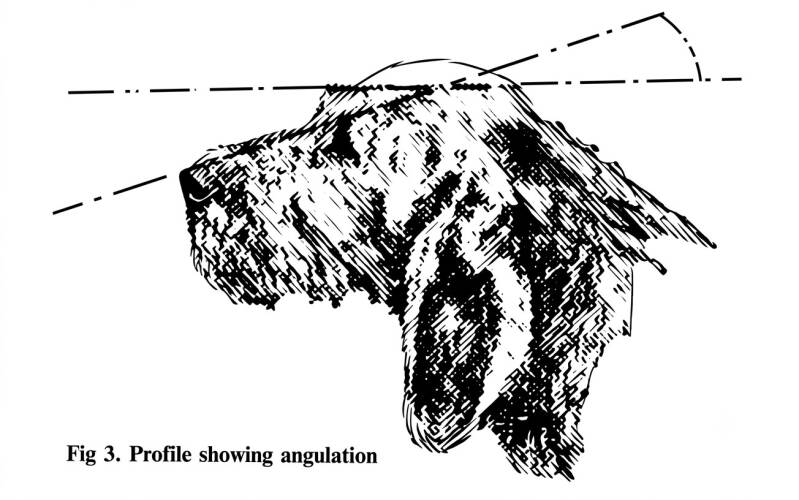
The coat should be tough, thick and slightly wiry rather close fitting to the body with the average length being 1½ to 2½ inches. To achieve this the coat must be stripped out twice a year. The skull hair must be stripped out to emphasise its oval shape, occipital protruberance and interparietal crest (see fig 3). The brows between the eyes are also removed revealing a pronounced medial furrow. The eyebrows and beard give the Spinone his nick-name of the "good natured grouch".
Vigorous
The thick heavy leathery skin is close-fitting to the body which together with the coat enables the Spinone to enter bramble and deep cold water without a second thought. The skin at the throat should be normal with a slight divided dewlap in such a way that the channels of the jaw and throat are clearly distinguishable.
The overall picture should be of a solid vigorous country dog with strong bone and well developed muscles.
Obviously I have not covered all there is to know; there are no breed experts or specialists in this country — we are all learning all the time, but hopefully working together we will improve and go from strength to strength. At the Spinone benches you will always find someone willing to talk Spinone, I'll not promise you that opinions won't vary, but it certainly will be interesting.
Bron Dogworld 1986/Tekst Caroline Spencer