

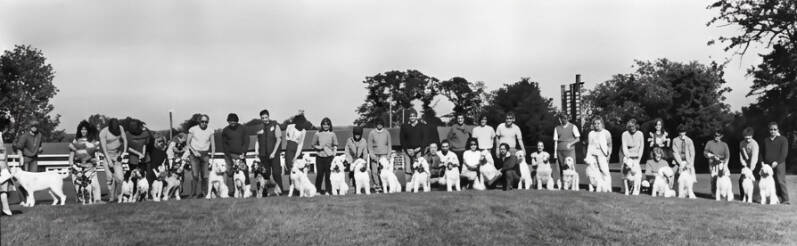
GENOA, Sept 13, 1986
Dear Jean,
My wife and I thank you and the members of the Italian Spinone Club of Great Britain for the wonderful hospitality which we received throughout our stay in the UK.
The Assessment held solely for Spinoni was an enormous success, not only because of the large number of exhibits present but more importantly for their great typicality and the high standard. When I think of the day I remember the beautiful heads I saw, the sweet and almost human expressions and the happy and uninhibited movement. The affection English people show to dogs in general, and in particular to Spinone, favours the growth of well adjusted animals without the complexes which usually cause timidity.
I saw excellent lines, well descended thoraxes and well sprung ribs with strong backs and correct toplines; an abundant and appropriate diet contributing to these points and eliminating the problem of rickets. I must stress that I was favourably impressed by the very high standard and the high percentage of 'Excellents' I was able to award. I congratulate the breeders in the UK for the good breeding which has had super results such as good pigmentation and dark eyes which is a great asset particularly for Spinoni with white/orange coats.
Will you please tell your fellow enthusiasts that I saw several tails which were too short. The tail should be docked at five to six vertebra from the root.
I witnessed exceptionally good texture in coats and beautiful thick skin but the coats were not always sufficiently stripped; the coat should be between four and six centimetres long and should never form fringes along the limbs or the pelvic line. Spinoni should have rear dewclaws and as they do not usually present problems in the field, it is not necessary to remove them.
I would like to recommend that the breeders in the UK who have taken so much care with conformation and breed points, gives some time to working their
Spinoni which I am sure will give them great satisfaction.
The working Spinone not only exhibits a natural ability to retrieve but is a very good hunter whether in open spaces, woods, marshes, etc, and because of his coat and the thickness of his skin he is a happy swimmer in any depth of water and can cope with the most adverse of weather conditions.
He excels when hunting woodcock, pheasant, duck, quail and partridge and when trained will be able to hunt for several days with elegance and pace, throughout the season. The trot is characteristic of the Spinone and distinguishes him from any other Continental dog. He is easily trained for work, with two or three outings a week all year but this very intelligent breed requires particular care and sensitivity on the part of the trainer.
When working large open spaces, particularly on partridge, he exhibits the characteristic trot with his head held high. Aware of even the weakest sound or scent, his body will become tense right to his tail, giving good indication of the presence of game and when certain of its presence he will slow down progressively until he comes to a statue-like stop.
In the woods hunting pheasant where the search is obviously restricted he always remains in close contact with his handler. He has a special passion for hare which he indicates with a beautiful point and when trained will sustain the chase with boundless energy.
The character of the Spinone is that of a jovial, good-natured chap who can also be a lively rascal, and even at times he can be a little reserved. He is extremely faithful and fond of his owners, becoming a true hunting companion and friend for life.
Dr A Storace, Il Presidente
I found this letter enlightening and the comments made, taken in conjunction with the specific notes he made on each dog, can only be considered helpful to our future breeding programmes.
May I conclude by saying that the Spinone is the dog for me as it will be for anyone who is on the receiving end of that very special Spinone look — soft, melting and humanlike is an understatement. This is a breed feature we must surely ensure is never lost, whatever the individual may regard as the correct 'type'.